Wednesday, August 13, 2008

Is Anandtech Any Help In Selecting A Computer?

In my last article I talked about trying to decide on a new computer system. My current plan is to put something together after I see how much difference Bloomfield and Deneb make. Information would be nice.

People keep asking me what is wrong with Anandtech's reviews. In all honesty I would love for Anandtech's reviews to be helpful and solid because this is not an easy time to be looking for a new system. The problem is that as I go over Anandtech's information I keep coming up empty.


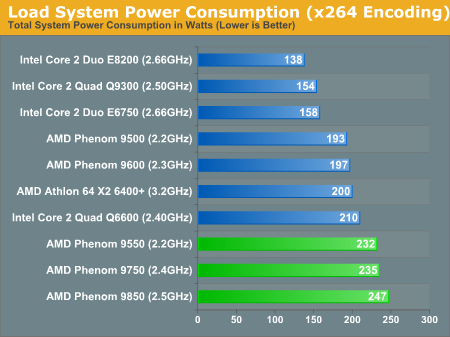
According to Anandtech's graph above, the Q9300 draws less power than the E6750. This would be quite impressive if true. However, this graph is easily falsified because according to Intel the E6750 is 65 watts whereas the Q9300 is 95 watts. So either Intel's documentation is wrong or Anandtech is. I'm pretty sure that Intel knows more about their processors than Anandtech so I'm going to have to assume the chart is wrong. And, this means that the comparison with AMD's processors is equally unreliable.

Okay, so no help on power draw. How about prices? The easiest way to see where the good prices are is to graph price versus clock. Generally the curve rises slowly and then much more steeply at some point. Anandtech seems to graph everything except these price curves. Doing my own I can see that AMD's curve is incredibly flat so there is no reason to buy anything less than a 9950 BE unless you are putting together a low end system and shopping for a dual core.

Of course dual cores and integrated graphics go hand in hand on a bargain system since you can get plenty of each for under $100. Unfortunately, Anandtech's 780G Preview isn't much help because they tossed out common sense by using the 45 watt, 2.5Ghz 4850E instead of the perfectly acceptable 65 watt, 2.7Ghz 5200+ which is the same price. However, a far better value would be spending $10 more and getting the 65 watt, 2.8Ghz 5400+ Black Edition with unlocked multiplier. Also, they didn't bother doing any real testing, just video playback, so the article is nearly worthless. Well, how about the IGP Power Consumption article? No, this article is particularly daft because it should already be obvious to everyone that integrated graphics consume less power than discrete video cards. Secondly, the article has no performance information so it is impossible to determine any value. So, how about the NVIDIA 780a: Integrated Graphics article? This article is also lacking because they use a 125 watt 9850 quad core. This is really bizarre considering their earlier insistence on a 45 watt chip. Wouldn't common 65/95 watt chips make more sense? They also leave out any comparison with Intel systems. This is quite odd since the inclusion of nVidia should have allowed a cross comparison by normalizing based on nVidia/AMD with nVidia/Intel. So, this is no help in choosing between an AMD and Intel system. Finally, the Intel G45 and AMD 790GX articles are only token announcements with no actual testing. Clearly if we are looking for a low end system Anandtech is no help at all.

But since I'm not looking for a bargain system I'm really more interested in quads. Even though it is obvious that the 9950BE is the best value in AMD quads the value of the 750 southbridge can't be determined by a price graph. Anandtech does have a 750SB article which does show increased overclocking as well as an increase in northbridge clock but since they fail to do any actual testing you have no idea what value this might be. If we wanted to find out about Intel overclocking then there is more information. Well, sort of. In Anandtech's Overclocking Intel's New 45nm QX9650: article he does overclock all the way up to 4.4Ghz. However, curiously missing are power draw and temperature graphs. In fact, besides synthetics there is almost nothing in the article. The article itself even admits this:

We hope to expand future testing to include real-world gaming results from some of the newest titles like Crysis, Call of Duty 4: Modern Warfare, Unreal Tournament 3, and Gears of War. Stay on the lookout for these results and others in our next look at the QX9650 when we pair this capable processor with the best motherboards companies like ASUS, Gigabyte, MSI, abit, DFI and Foxconn have to offer.

The problem is that this article is from December 19, 2007 and eight months later there is still no followup article. Anandtech does however have articles on Atom, Larrabee, and Nehalem which also have little value in choosing a system today. However, Anandtech's Nehalem article is quite odd because it says:

We've been told to expect a 20 - 30% overall advantage over Penryn and it looks like Intel is on track to delivering just that in Q4. At 2.66GHz, Nehalem is already faster than the fastest 3.2GHz Penryns on the market today.

If this is true then Intel hasn't just shot itself in the foot; it has taken a chainsaw to both legs. This would mean that the value of Intel's entire 45nm quad line has just dropped through the floor and the effect on the 65nm line would be even worse. Considering that today Intel is only at 1/3rd 45nm production by volume this would mean that Intel would have massively reduced the value of most of its line. And, if this is true then no one should buy anything higher than Q6600 until Bloomfield is released. The problem with this scenario is that Intel already went down this road with PII and PII Celeron so I doubt it will make this mistake again.

Graphics are also a bit strange at Anandtech. For example, in the HD 4870 article Anand says:

For now, the Radeon HD 4870 and 4850 are both solid values and cards we would absolutely recommend to readers looking for hardware at the $200 and $300 price points. The fact of the matter is that by NVIDIA's standards, the 4870 should be priced at $400 and the 4850 should be around $250. You can either look at it as AMD giving you a bargain or NVIDIA charging too much, either way it's healthy competition in the graphics industry once again (after far too long of a hiatus).

So, he likes the HD 4870. And, in the NVIDIA GeForce GTX 280 & 260 article he said:

the GeForce GTX 280 is simply overpriced for the performance it delivers. It is NVIDIA's fastest single-card, single-GPU solution, but for $150 less than a GTX 280 you get a faster graphics card with NVIDIA's own GeForce 9800 GX2. The obvious downside to the GX2 over the GTX 280 is that it is a multi-GPU card and there are going to be some situations where it doesn't scale well, but overall it is a far better buy than the GTX 280.

Keep in mind that the 9800 GX2 is dual GPU and cost $500 at the time of the article. The tone changes however in the Radeon HD 4870 X2 article. Anand admits:

The Radeon HD 4870 X2 is good, it continues to be the world's fastest single card solution

He also says:

But until we have shared framebuffers and real cooperation on rendering frames from a multi-GPU solution we just aren't going to see the kind of robust, consistent results most people will expect when spending over $550+ on graphics hardware.

So, he doesn't have a problem endorsing a $500, dual GPU card from nVidia yet he balks at endorsing a $550, dual GPU card from AMD that is much more powerful. This does seem more than a little arbitrary.

I might be interested in Linux but Anandtech hasn't done a Linux review since 2005. It is possible that they lost all of their Linux expertise when Kristopher Kubicki left. That's too bad but with a quad core I am very interested in mixed performance but Anandtech likewise has not done mixed testing since 2005 even under Windows. Yet, this is what the processor would typically be doing for me, running two or three different applications. Under normal circumstances I wouldn't be running four copies of the same code nor would I be splitting up one application among four cores but this is the only type of testing Anandtech does these days. This leaves a huge gap between the typical Anandtech testing which is only suitable for single and to some extent dual cores and the all out quad socket/quad core server benchmarks that they ran.

The bottom line is that Anandtech's testing is only dual core caliber (when it is accurate). However, the poor integrated graphics testing offers no help for a typical system that would be used with dual core. But even in the area of quad core/discrete graphics where Anandtech should be strong you have to deal with their schizophrenic attitude about multi-card/dual card graphics and their ambivalent attitude about power consumption. Pricing seems to get similar ill treatment at Anandtech mostly as a crutch when it happens to support their already drawn conclusions. So, my conlusion would have to be that Anandtech isn't much help in choosing a computer system.
Monday, August 11, 2008

A Difficult Season For PC Shopping

I'll probably buy a new computer within a few months. Since I'm not likely to buy another one for two or three years this is a difficult decision and I've begun the long process of figuring out what to buy.

I suppose shopping for a PC is never a truly easy task but it seems that right now this task has become twice as hard. I think Tom's Hardware Guide said it well:

If you already have a Core 2 system or a fast Athlon 64 X2 or Phenom, you shouldn't’t rush now. It makes more sense to for wait for Intel’s Nehalem architecture with the X58 chipset, as well as AMD’s Socket AM3 platform.

The problem is that I don't have a either a Core 2 or X2. I have a 1.8Ghz P4 desktop system and a 2.0Ghz Athlon 64 notebook. But, I'm also not really wanting to wait another full year to make a purchase. I guess there is nothing to do but try to slog through this methodically and see if some configuration makes sense.

I checked the prices of CPU's on NewEgg and others and put these into a spreadsheet graph. It is obvious that none of the processors above 2.8Ghz are cost effective; you get only a tiny bit more performance for a big increase in price. The AMD curve is quite odd because it actually gets flatter above 2.3Ghz. Consequently, the 2.6Ghz 9950 Black Edition at $235 ends up being the only real choice. However, I'm not sure I want a 140 watt processor. On the Intel side the venerable Q6600 doesn't seem to be as good a bargain as it used to be. The two best choices seem to be the 2.66Ghz Q6700 for $275 or the 2.83Ghz Q9550 for $340. These are both 95 watt processors. AMD's fastest 95 watt processor the 2.4Ghz 9750 seems to be scarce these days. This is probably irrelevant though since you could always run the 9950 at 2.4Ghz and get the same wattage. So, again, on the AMD side, the 9950 BE seems to be the only current choice.

For future choices the 2.66Ghz Bloomfield is expected to cost $284. This makes it comparable in price with Q6700. The X58 chipset is a bit of a wild card at the moment but if it were a reasonable price this would probably knock the Q6700 out of the running. The P45 chipset wasn't received as favorably so this would seem to make it a choice between Q9550 with P35/X48 and Bloomfield/X58. However, if X48 begins to look best I would have to compare with nVidias chipsets as well.

I have no idea what AMD's 45nm Deneb might run but given the current prices it should have some room to increase. So, we're probably talking a 2.6 - 2.83Ghz chip in the $235-$340 range with both Intel and AMD having chips that fit. As far as I know, AMD wouldn't be changing chipsets so we should be looking at a 790GX or FX chipset with a 750 southbridge. There doesn't seem to be any good reason to look at the nVidia chipsets since they don't have the 750 southbridge ACC capability. I like this feature because not only should it allow higher overclocks it should allow less power draw at the same clock as well.

For graphics I'm looking at $200-$400 range which should include nVidia's 9800X2, GTX 260 as well as AMD's HD 4850 and 4870. There will probably be others though by October. However, I suppose a PCIe 2.0 card would make it necessary to re-examine the Intel P45 chipset and drop the P35. Running a search it appears that if I require two PCIe 2.0 ports then the choice becomes X38/X48, P43/P45, or nVidia nForce 700. Overall I doubt the motherboard is going to be much of a factor unless the X58 is particularly high. I would probably use four harddrives in a RAID 5 which should mean a mid case or larger. I haven't decided how big of a power supply to get. Right off hand I would say 4-8GB of memory. I would probably dual boot Unix/Windows but not sure which version of Unix. At the moment I'm leaning towards the Dragonfly version of BSD. I'm probably looking at a 22-26" LCD monitor but I can see right now I'm going to have to go over all the technical details of response time, contrast, and viewing angle to pick one. This is going to take some time so I suppose it is good to start now. Also, I imagine I'm going to have to revisit this topic after the release of the newer graphics cards and then Bloomfield and Deneb.

Monday, July 14, 2008

Reviews And Fairness Or How To Make Intel Look Good

I've had people complain that I've been too tough on Anand but in all honesty Anandtech is not the only website playing fast and loose with reviews.

Anand has made a lot of mistakes lately that he has had to correct. But, aside from mistakes Anand clearly favors Intel. This is not hard to see. Go to the Anandtech home page and there on the left just below the word "Galleries" is a hot button to the Intel Resource Center. Go to IT Computing and the button is still there. Click on the CPU/Chipset tab at the top and not only is the button still there on the left but a new quick tab to the Intel Resource Center has been added under the section title right next to All CPU & Chipset Articles. Click the Motherboards tab and the button disappears but there is the quick tab under the section title. There are no buttons or quick tabs for AMD. In fact there are no quick tabs to any company except Intel. Clearly Intel enjoys a favored status at Anandtech.

What we've seen since C2D was released is a general shift in benchmarks that favor Intel. In other words instead of shooting at the same target we have reviewers looking to see where Intel's arrows strike and then painting a bullseye that includes as many of them as possible. For example, encryption used to be used as a benchmark but AMD did too well on this so it was dropped and replaced with something more favorable to Intel. There has been a similar process for several other benchmarks. Of course now it isn't just processors. Reviewers have carefully avoided comparing the performance of high end video cards on AMD and Intel processors. Reviews are typically done only on high end Intel quad cores. The claim is that this is for fairness but it also avoids showing any advantage that AMD might have due to HyperTransport. It is a subtle but definite difference where review sites avoid testing power draw and graphic performance with just Integrated Graphics where AMD would have an advantage. They then test performance with only a mid range graphic card to avoid any FSB congestion which again might give AMD an advantage. Then high end graphics cards are tested on Intel platforms only which avoids showing any problems that might be particular to Intel. We are also now hearing about speed tests being done with AMD's Cool and Quiet turned on which by itself is good for a 5% hit. I suppose reviewers could try to argue that this is a stock configuration but these are the same reviewers who tout overclocking performance. So, by shifting the configuration with each test they carefully avoid showing any of Intel's weaknesses. This is actually quite clever in terms of deception.

As you can imagine the most fervent supporters of this system are those like Anand Lal Shimpi who strongly prefer Intel over AMD. I had one such Intel fan insist that Intel will show the world just how great it was when Nehalem is released. However, I have a counter prediction. I'm going to predict that we will see another round of benchmark shuffling when Nehalem is released. And, I believe we will see a concerted effort to not only make Nehalem look good versus AMD's Shanghai but also to make Nehalem look good compared to Intel's current Penryn processor. It would be a disaster for reviewers to compare Nehalem and conclude that no one should buy it because Penryn is still faster . . . so that isn't going to happen.

An example is that since AMD uses separate memory areas for each processor it needs an OS and applications that work with NUMA. In the past reviewers have run OS's and benchmarks alike oblivious to whether they worked with NUMA or not. If anything seems to be overly slow they just chalk it up to AMD's smaller size, lack of money, fewer engineers, etc. Nehalem however also has separate memory areas and needs NUMA as well. I predict that these reviewers will suddenly become very sensitive to whether or not a given benchmark is NUMA compatible and will be quick to dismiss any benchmark that isn't. This may extend so far as to purposefully run NUMA on Penryn to reduce its performance. This would easily be explained away as a necessary shift while ignoring that it wasn't done for K8 or Barcelona. That would be explained away as well by saying that the market wasn't ready for it yet when K8 was launched. That was what happened with 64 bit code which was mostly ignored. However, if Intel had made the shift to 64 bits reviewers would have fallen all over themselves to do 64 bit reviews and proclaim AMD as out of date just as they did every time Intel launched a new version of SSE.

We see this today with single threaded code. C2D and Penryn work great with single threaded code but have less of an advantage with multi-threaded code and no actual advantage with mixed code. It is a quirk of Intel's architecture that sharing is much more efficient when the same code is run multiple times. If you compared multi-tasking by running a different benchmark on each core Intel would lose its sharing advantage and have to deal with more L2 cache thrashing. Even though mixed code tests would be closer to what people actually do with processors reviewers avoid this type of testing like the plague. The last thing they want to do is have AMD to match Intel in performance under heavy load or worse still actually have AMD beat a higher clocked Penryn. But Nehalem uses HyperThreading to get its performance so I predict that reviewers will suddenly decide that single threaded code (as they prefer today) is old fashioned and out of date and not so important after all. They will decide that the market is now ready for it (because Intel needs it of course).

Cache tuning is another issue. P4EE had a large cache as did Conroe. C2D doubled the amount of cache that Yonah used and Penryns have even more. However, reviewers carefully avoid the question of whether or not processors benefit from cache. This is because benchmark improvements due to cache tend to be paper improvements that don't show up on real application code. So, it is best to avoid comparing processors of different cache sizes to see benchmarks are getting artificial boosts from cache. I did have one person try to defend this by claiming that programmers would of course write code to match the cache size. That might sound good to the average person but I've been a programmer for more than 25 years. Try and guess what would happen on a real system if you ran several applications that were all tuned to use the whole cache. Disastrous is the word that comes to mind. But you can avoid this on paper by never doing mixed testing. A more realistic test for a quad core processor is to run something like Folding@Home on one core and graphic encoding on another while using the remaining two to run the operating system and perhaps a game. Since the tests have to be repeatable you can't run Folding@Home as a benchmark but that isn't a problem since it is the type processing that needs to be simulated rather than the specific code. For example you could probably run two different levels of Prime95 tests in the background while running a game benchmark on the other two cores to have repeatable results. And, if you do run a game benchmark on all four cores then for heavens sake use a high graphic card like a 9800X2 instead of an outdated 8800.

Cache will be an issue for Nehalem because it not only has less than Penryn but it has less than Shanghai as well. It also loses most of its fast L2 in favor of much slower L3. My guess is that if any benchmarks are faster on Penryn due to unrealistic cache tuning this will be quickly dropped. That reviews shift with the Intel winds is not hard to see. Toms Hardware Guide went out of its way to "prove" that AMD's higher memory bandwidth wasn't an advantage and that Kentsfield's four cores were not bottlenecked by memory. But now that Nehalem has 3 memory channels the advantage of more memory bandwidth is mentioned in every preview. We'll get the same thing when Intel's Quick Path is compared with AMD's HyperTransport. Reviewers will be quick to point to raw bandwidth and claim that Intel has much more. They of course will never mention that the standard was derated from the last generation of PCI-e and that in practice you won't get more bandwidth than you would with HyperTransport 3.0.

I could be wrong; maybe review sites won't shift benchmarks when Nehalem appears. Maybe they will stop giving Intel an advantage. I won't hold my breath though.

Addition:

We can see where Ars Technica discovers PCMark 2005 error. Strangely the memory score gets faster when PCMark thinks the processor is an Intel than when it thinks it is a an AMD. Clearly the bias is entirely within the software since the processor is the same in all three tests:


I've had Intel fans claim that it doesn't matter if Anandtech cheats in Intel's favor because X-BitLabs cheats in AMD's favor. Yet, here is the X-Bit New Wolfdale Processor Stepping: Core 2 Duo E8600 Review from July 28, 2008. In the overclocking section it says:

At this voltage setting our CPU worked stably at 4.57GHz frequency. It passed a one-hour OCCT stability test as well as Prime95 in Small FFTs mode. During this stress-testing maximum processor temperature didn’t exceed 80ÂșC according to the readings from built-in thermal diodes.

This sounds good but the problem is that to properly test you have run two separate copies of Prime95 with core affinity set so that it runs on each core. This article doesn't really say that they did that. There is a second problem as well dealing with both stability and power draw testing:

We measured the system power consumption in three states. Besides our standard measurements at CPU’s default speeds in idle mode and with maximum CPU utilization created by Prime95

This is actually wrong; the Prime95 test they peformed was not maximum power draw; it was Prime95 in Small FFTs mode. But this doesn't agree with Prime95 itself which clearly states in the Torture Test options:

In-place large FFTs (maximum heat, power consumption, some RAM test)

So, the Intel processors were not tested properly. Using the small FFTs does not test either maximum power draw or temperature and therefore doesn't really test stability. If any cheating is taking place at X-Bit, it seems to be in Intel's favor.