Showing posts with label Anandtech. Show all posts

Thursday, August 13, 2009

Notebook Confusion: Another Bizarre Anandtech Review

I came across an Anandtech Notebook Review by Jarred Walton that claims to objectively compare low end examples powered by AMD and Intel processors. The reality seems to be otherwise.

I use an AMD notebook everyday. Mine is an older HP Pavillion with a 2.0Ghz Mobile Athlon 64 processor. It has a 15.4" display that can do 1280 x 800. I also have a very similar HP Pavillion Centrino system with a 2.0Ghz Pentium M processor. Both run Windows XP. The main difference between them is that the AMD system only has 512 MB's of memory while the Centrino has 1 GB. That actually isn't as simple as it appears because the Radeon 200M graphics in the AMD system have their own 128 MB graphics buffer while the Centrino uses main memory. So, it would be more like 640 MB's versus 1024 MB's. Therefore, we should have similar CPU power with a small advantage in memory for the Centrino.

In daily use, my notebook spends most of its time with the processor running between 800 and 1,000 Mhz so I was more than a little surprised to see Mr. Walton claiming that the AMD notebook in review with a dual core 2.1 Ghz processor doesn't have enough processor power. Whose leg are you trying to pull, Mr. Walton? Mr. Walton indeed suggests with a straight face that the Intel system is snappier. However, unless he is claiming that Vista requires twice as much CPU power to run then this claim is simply plucked out of thin air and cannot be taken seriously.

My two notebooks have very similar performance and utility for most things. Graphics are important though. I have a low end Sempron desktop system with again similar CPU power but the display only goes up to 1024 x 768 and that is quite noticeable. The 1280 x 800 is much easier to work with. If I were limiting the discussion to things like surfing the internet, using a word processor or spreadsheet then in all honesty I can't see much difference between the two systems. Mr. Walton makes the dubious claim that the Intel system is 25% more powerful so the extra cost is still a bargain. This claim is a joke. The reality is that Mr. Walton is scrambling to invent some reason to give the win to Intel and has gotten a death grip on the only advantage he was able to find: the Intel system does have slightly more CPU power. Seriously, I've never spent any time wishing I had 25% more CPU power and the two systems in review with more than double what I have should be plenty.

However, I have done some light game playing on my notebooks. I have played Empire Earth, Empire Earth II, Warcraft 3, Civilization 3 and 4, and Colonization 4. These will all run on my AMD notebook. Warcraft 3 does not run well on the Sempron desktop due to the lower resolution nor can it run Civ 4 at all. The Centrino system can run Warcraft 3 and I have played against someone using the LAN option. However, I do have to reduce my resolution because the Centrino system with native Intel graphics cannot handle the same resolutions that my Radeon graphics can. Worse still is that the Centrino system cannot run Civ 4 at all.

So, with all due respect to Mr. Walton's prejudices, let's stop the baloney. For almost all normal activity both systems have more than enough CPU power. This simple fact tends to negate Mr. Walton's desperate claim of a CPU power advantage. However, it does not negate the fact that the Intel system costs more and that it truly does have worse graphics than the AMD system. I suppose if you use your notebook for running obscure benchmarks then you would agree with Mr. Walton. However, for real people who actually use their computers I would say that either computer would be fine but with better graphics and a lower pricetag for the AMD system it would difficult to find a reason to buy the Intel system.

Still waiting for the day when the sun rises, flowers bloom, and common sense returns to Anandtech.


On another note: the AMD 3.4 Ghz Phenom II 965 Black Edition has finally arrived. It looks like a nice chip but since it is 140 watts I'm still deciding if it is preferable to the 125 watt PII 955 BE. I suppose if the 965 were downclocked to 3.2 Ghz then it might pull the same. But the real question is whether the 965 has an advantage if for example I am not trying for the highest possible clock. Good question.

Thursday, February 12, 2009

Example Systems

I've been looking over the example systems at Anandtech. For the most part they do make reasonable choices. However, sometimes they betray definite biases in either choice of processor or their desire for overclocking instead of practicality.

Some things just naturally divide into sections, like oranges for example. But computer systems like most things take a bit more effort. However, there are a few common sense rules that help. First of all, as cost increases it has to increase overall, not just in one area. For example, it would be silly to keep memory, harddrives, and video the same but triple the cost of the CPU. As a very good rule of thumb, the drive cost, memory cost, video and display costs will all increase proportionately. Also, not only will the cost increase but so will the capacities. A more expensive system should have a faster (or higher core) CPU, more (and possibly faster) memory, more harddrive capacity (and perhaps speed), higher resolution video and a larger monitor. We would also have to increase power supply size to match the greater system demands and we would probably make some minor upgrades to case, keyboard, mouse, speakers, and perhaps audio. Secondly, if we are going to compare systems then they must have comparable capacities and attributes, not simply comparable costs. Without this common sense notion we could easily end up comparing one system where we spend $500 on audio/video/display and $200 on CPU/motherboard/memory with another that does just the opposite. Yet, it should be obvious that a system that is heavy on AV and light on CPU would be a completely different animal than one that is heavy on CPU and light on AV even if they happen to have the same pricetag.

Looking over the most recent example systems at Anandtech we see 5 categories: Value, Budget, Midrange Value, Midrange Performance, and i7 Overclocking and Dream. Not only are the names a bit confusing but the cost spread is absurd. The first system starts at about $540 which is fine but the cost to move up to each higher system progresses like this: $300, $600, $570, $140, and $2690; this isn't much of a spread. As you move up in price the cost of everything increases so the price between systems also increases. It makes no sense that the the third increase is smaller than the second and makes even less sense that the fourth increase is only half of the first. A more common sense spread would be something like: $300, $450, $600, and $750. So, if we start at $550 then our target systems would cost: $550, $850, $1300, $1900, and $2650. But then we have to skip $3550 to reach AT's Dream system price at about $4600.

The AMD entry and Intel entry level systems listed by Anandtech aren't too bad. However, I would cut the memory in half to 2GBs and we could easily get a midtower case for $25 and a nice CoolerMaster 460 watt power supply for $35. We would end up with the same $60 pricetag as AT but with a better PSU. Next, we can see that Anandtech tried to pull a fast one by sneaking in the too expensive E5200 Wolfdale for the Intel system. They then tried to cover this up by artificially jacking up the AMD motherboard cost. Tsk, tsk. The nVidia 7100 motherboard for $60 for the Intel system is fine but the actual equivalent AMD motherboard would only cost $55 for a 690/740 board (instead of $80 for a 780G board like AT used). So, we toss out the $80 E5200 Wolfdale and $80 AMD motherboard and see what is around $60. We end up with an AMD 2.7Ghz 7750 dual core Kuma and Intel 2.2Ghz 1500 dual core Celeron for about $63. We end up with a system cost of $489. This is a pretty good price for an entry level system. But, for about $40 more we could upgrade to 4GB of memory and either upgrade the AMD to 780G graphics or the Intel to 9000 series nVidia graphics.

Our target is $850 for the next system. I would probably bump the case up to a $38 Gigabyte mid tower and the power supply to the 550 watt CoolerMaster for $60. And, double the amount of system memory to 4GBs of DDR2 for $45. I would probably go with a $105 790GX board. This would give the AMD system adequate graphics for most uses including sims and mid level gaming. Unfortunately, AT has once again tried to pull a fast one by using a $120 Intel board and then putting in an $85 graphic card to hide Intel's weak onboard graphics. Tsk, tsk. So, we toss out the Intel board with junk graphics and use an nVidia board instead. The equivalent 9000 series board will run just $5 more at $110. The target price for processor is $90. For Intel this means either an $85 2.6Ghz E5300 or $95 2.7Ghz E5400 dual core. With AMD it means either using the older and only slightly faster 3.0Ghz dual core 6000+ Windsor or using the slower clocked triple core 2.3Ghz 8650 Toliman. The Toliman is the better choice since this gives a boost of about 28% albeit at the cost of single threaded performance. Next, rather than increasing the size of the single harddrive (like AT did) I would add a second harddrive as a work drive. This means bumping the harddrive cost from $85 to $120 for two 500 GB drives. Even so, we end up with a system cost of $750. We might drop down to $80 AMD and Intel motherboards without graphics and then add an HD 4650 for $60. This would give us a good balance and still only $780.

For our next system we have a target of $1300. The example systems in this range are not very balanced. In particular the Intel system ends up quite top heavy in audio/video. We can get a good motherboard for $120, upgrade the speakers to $70, $80 for case, and a Blu-Ray drive for $105. $200 for a 21" widescreen monitor seems fine. But the power supply is more of a problem. To make sure we have some flexibility we need something SLI and Crossfire certified. And, this means moving up to $120 for a 650 watt certified CoolerMaster. On the other hand, standard motherboards have pretty good sound so we drop the $50 sound card. We then upgrade the memory to 8GBs. The target for the CPU is $150. The obvious choice for AMD is the triple core Phenom II X3 720 2.8Ghz Black Edition for $150. However, with Intel we face the same problem we did with AMD on the previous system. We could go with the 2.93Ghz E7500 dual core for $140 but a better choice would be to move up to $170 and use the slower clocked 2.33Ghz Q8200 quad core. I would replace the work drive with a 1 TB drive and increase the memory to 6 GBs. I would probably have to go with a $90 4830 video card and we end up with a system cost right at our target of $1300.

The target price for the third system is $1900. We upgrade the mouse, keyboard, and speakers. We upgrade the case to $100 and the power supply to a 750 watt certified CoolerMaster for $130. We upgrade to two 1 TB drives for $200. We upgrade the monitor to a 24" for $290. The target price for the CPU is $235. For $230 for AMD we have the quad core 3.0Ghz Phenom II X4 940 and for Intel we have the quad core 2.66Ghz Q9400 for the same price. We upgrade the memory to 8 GBs. And, we'll use an HD 4870 for $200. We upgrade the HSF and end up at about $1850. Anandtech's Entry Level i7 system should be in this range because by the time you balance the system (with more memory, better monitor, etc.) you end up at about $2100 instead of $1450.

This leaves the final two systems. We have the i7 Overclocking system. Unfortunately, their choices for system components are somewhere between absurd and psychotic. You simply can't build a balanced system for $2140 when the CPU, memory, and motherboard are so expensive and 3GB's of memory on a system over $2000 is a real knee slapper. We need to bump the target price up to $2650. Their choices for mouse, keyboard, speakers, optical drive, case, and monitor are fine. But, they completely blew it in terms of memory, harddrives, video card and power supply. Let's start with a Zalman 1000 watt certified power supply for $290. The target price for the CPU is $330 so the 2.66Ghz i7 920 for $290 is good. We need at least 9GBs of DDR3, not 3 GBs. The harddrive is also a joke. I would bump that to three 1 TB drives. And, although the $190 Blu-Ray burner is fine I would add a second regular Blu-Ray drive for $105. And we need to change the video card to a dual HD 4870 X2 for $440. We find that we are unable to hit the target and end up with a well balanced system price of around $2900. Similarly a good i7 Dream system cannot be built for what they claim. By the time you balance the system the price without SSD is around $5600. To be honest, I'm sceptical of Anandtech's conclusion that i7 was the only choice for a Dream system. The truth is that while none of AMD's desktop processors are in this performance class you could make a good argument that you could build an even more powerful system using dual Opteron 2380's.

Saturday, January 17, 2009

Seeking A New System

Finally, information is arriving on Phenom II (Shanghai) versus Penryn and i7 (Nehalem). It's time to start thinking about a new desktop.

Generally when I buy a new system I end up getting something 3X more powerful than my old system. However, the last time I bought a new computer I wanted a notebook so I ended up getting a desktop replacement system with a 2.0Ghz mobile Athlon 64 which is only about 67% faster than my old P4 1.8Ghz system. This has put me a little behind so I would really like something about 9X faster than the old P4 to catch up. This requirement would be met with a tri-core of 3.0Ghz or a quad of only 2.3Ghz. There are no X3's available at 3.0Ghz yet but both Intel and AMD easily fulfill the quad requirement. However, I was reminded of Anandtech's past views about processor value after some back and forth with Johan De Gelas.

AMD's dual core Opteron & Athlon 64 X2 - Server/Desktop Performance Preview

"The real problem is that AMD has nothing cheaper than $530 that is available in dual core, and this is where Intel wins out. With dual core Pentium D CPUs starting at $241, Intel will be able to bring extremely solid multitasking performance to much lower price points than AMD"

Athlon Dual Core: Overclocking the 4200+

"The pricing, however, was a little hard to swallow with the range from just over $500 for the lowest-priced 4200+ to around $1000 for the top-line . . .

With the 4400+ sporting 1MB cache on each core, and only a few dollars more than the 512KB 4200+, we would suspect the 4400+ may well be the Dual-Core to buy
"

Affordable Dual Core from AMD: Athlon 64 X2 3800+:

"and today, AMD is launching it - the $354 Athlon 64 X2 3800+; the first somewhat affordable dual core CPU from AMD.

The cheapest dual core Pentium D processor could be had for under $300, yet AMD's cheapest started at $537. Intel was effectively moving the market to dual core, while AMD was only catering to the wealthiest budgets.

The Pentium D 820, running at 2.8GHz and priced at $280, offered the most impressive value that we've seen in a processor in quite some time
"


Of course, Anandtech has been leaning towards Intel for so long, I doubt they even remember what they said back in 2005. I suppose this could be why Anandtech never complains about price with Intel's Nehalem or Q9650 as they did (over and over) with AMD's X2. So, a $500 pricetag is "catering to wealthiest budgets", $354 is only "somewhat affordable", $280 is "impressive value", and more L2 cache is better at $44 because this is "only a few dollars more". I suppose someone could argue that inflation has raised the price point since 2005 however this has been more than offset by the decrease in system prices. So, let's see what happens if we use Anandtech's past, vigorously defended (but now apparently forgotten) criteria with today's chips:

We immediately eliminate the Intel i7 940 at $565 and Q9650 at $550 plus anything higher. At first glance, i7 920 would seem to be okay at $295. However, by the time we allow for the extra money required for the more expensive X58 motherboard and DDR3 memory we are again back up to $500, so it gets eliminated as well. This leaves Q9550 and below. However, Anandtech also preferred the 4400+ because it had twice as much L2 cache as the 4200+. This would make it very difficult to choose the $250 2.66Ghz Q9400 with 6MB L2 over the faster $295 2.83Ghz Q9550 with 12MB L2. In fact, the difference in price is almost identical to the difference between the 4400+ and 4200+. And, if double the cache is good at $44 then presumably triple the cache would be equally good at $66. But with only 1/3rd the cache the Q8300 is only $57 cheaper so it gets eliminated too. For Intel this only leaves the $190 2.4Ghz Q6600 with 8MB L2 and the $180 2.33Ghz Q8200 with 4MB L2. So, we have a choice between the outdated B3 stepping Q6600 and the newer 45nm Q8200 with half as much cache.

1/20/2009: The prices changed since I wrote this so I'll amend my comments. The Intel 3.0Ghz Q9650 is now "somewhat affordable" at $350and therefore at the top of the midrange. It is not a great bargain since 20% more money only gets you 6% more performance. Or, at least it does as long as the code can run from the L2; Q9650 shares the same FSB bottleneck as Q9550. The price of Q9550 has hardly change and at $290 is just $5 cheaper than it was. The Q9400 still gets eliminated because of the $50 price difference and half the cache but we retain Q8300 at $205 because it is now $85 cheaper than Q9550.

The problem is that AMD had price drops as well cutting Phenom II by $40. This makes Q9550 less of a bargain since PII 940 is now $55 cheaper. This is enough for a nice upgrade on the video card and to be honest I'd rather have a PII 940 with an HD 4850 than a Q9550 with an HD 4830. The drop in price with PII 920 to just $195 now makes it quite a value and throws a big monkey wrench into Intel's prices. Q9400, Q8300, Q6600, and Q8200 are all now about $45 too expensive. A choice between a cache crippled 2.33Ghz Q8200 for $170 and a PII 920 at 2.8Ghz for just $25 more is a no brainer. On the other hand, a Toliman system would be $50 cheaper again allowing a nice video upgrade.


If I were looking for a stopgap system I might go with the Intel $190 Q6600 or $180 Q8200. The AMD Black Edition Phenoms for $150 these days are also a bargain as is the $119 2.4Ghz 8750 BE Toliman tri-core when matched up with a 750 southbridge. I would be comfortable with any of these chips on a bargain or stopgap system. However, since AMD tripled the L3 on with its newer chips we are again pushed towards the $235 Phenom II X4 920 at 2.8Ghz or the $275 Phenom II X4 940 BE at 3.0Ghz for a midrange system.

I don't usually bother overclocking but this is a pretty simple operation if you match a 750 southbridge with the AMD quads. If I were comparing with the 9950 BE or 8750 BE in terms of overclocking I might give the B3 Q6600 the benefit of the doubt. But in the company of the newer 45nm chips the vintage Q6600 is clearly out of its league in terms of overclocking. Given a choice between the 920 and 940 AMD quads I would have to choose the 940 because its Black Edition unlocked multiplier would make it easier to overclock.

The Intel Q9550 is technically faster however it gets choked by its slower 1333Mhz FSB. To match the AMD 940 it would need 2133Mhz.However, even the still slower 1600Mhz FSB is only available on the insanely overpriced QX9770 for $1,460. Intel integrated graphics still lag behind both nVidia and AMD, so an nVidia motherboard is required for Intel unless I want to add a discrete graphics card from the start. The Dragon platform is the obvious choice for AMD although nVidia options are only a little worse in terms of integrated graphics.

For a discrete graphics card the 4000 series would be the obvious choice for something from AMD (ATI). I would probably be looking at a $140 HD 4850 or the $100 HD 4830 (which is about 75% of the 4850's performance). The nVidia equivalent of 4830 would be the 9800GT at $115 and the 4850 equivalent would be the 9800GTX+ at $165. The problem is that for $165 I can get a 1GB 4850 instead of a 512MB. And, if I move up to the 1GB size of 9800GTX+ I'm at $185 which is only $5 less than the much more powerful HD 4870. The GT260 is more expensive for less performance than the 4870 so it isn't worth considering.

I also wasn't exactly surprised with Anandtech's conclusion in AMD Phenom II X4 940 & 920: A True Return to Competition:

"Compared to the Core 2 Quad Q9400, the Phenom II X4 940 is clearly the better pick. While it's not faster across the board, more often than not the 940 is equal to or faster than the Q9400. If Intel can drop the price of the Core 2 Quad Q9550 to the same price as the Phenom II X4 940 then the recommendation goes back to Intel. The Q9550 is generally faster than the 940"

This conclusion is a bit out of whack since their own data shows that 940 compares favorably with Q9550. I would also guess that 940 would compare even better if Anandtech stopped avoiding mixed testing (for the past two years).

At any rate, I tend to agree with the guidelines that Anandtech used back in 2005. Today, I could easily recommend a Core 2 Quad Q9550 system with Intel motherboard if someone were planning to add discrete graphics anyway or with an nVidia motherboard for its better integrated graphics. An equally good choice would be a Phenom II 940 system with either discrete graphics or integrated graphics on a AMD Dragon platform. An nVidia motherboard would be adequate with Phenom II but if an older Phenom or Toliman were chosen then an AMD motherboard with 750 southbridge would be preferred.

1/20/2009: With the current prices the Q9550 is still acceptable but a worse bargain than a PII 940 system. In other words, with equivalent price it would be nearly impossible to assemble a Q9550 system equal to the PII 940 system. The drop in the PII 920 price has also greatly reduced the value of the lower end Intel quads and I could no longer recommend them even for a bargain or stopgap system. If you have money to burn, the Q9650 is less value for the money but would be an upgrade over a PII 940 or Q9550 system.

Wednesday, August 13, 2008

Is Anandtech Any Help In Selecting A Computer?

In my last article I talked about trying to decide on a new computer system. My current plan is to put something together after I see how much difference Bloomfield and Deneb make. Information would be nice.

People keep asking me what is wrong with Anandtech's reviews. In all honesty I would love for Anandtech's reviews to be helpful and solid because this is not an easy time to be looking for a new system. The problem is that as I go over Anandtech's information I keep coming up empty.


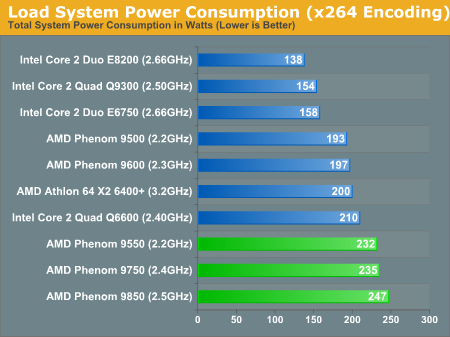
According to Anandtech's graph above, the Q9300 draws less power than the E6750. This would be quite impressive if true. However, this graph is easily falsified because according to Intel the E6750 is 65 watts whereas the Q9300 is 95 watts. So either Intel's documentation is wrong or Anandtech is. I'm pretty sure that Intel knows more about their processors than Anandtech so I'm going to have to assume the chart is wrong. And, this means that the comparison with AMD's processors is equally unreliable.

Okay, so no help on power draw. How about prices? The easiest way to see where the good prices are is to graph price versus clock. Generally the curve rises slowly and then much more steeply at some point. Anandtech seems to graph everything except these price curves. Doing my own I can see that AMD's curve is incredibly flat so there is no reason to buy anything less than a 9950 BE unless you are putting together a low end system and shopping for a dual core.

Of course dual cores and integrated graphics go hand in hand on a bargain system since you can get plenty of each for under $100. Unfortunately, Anandtech's 780G Preview isn't much help because they tossed out common sense by using the 45 watt, 2.5Ghz 4850E instead of the perfectly acceptable 65 watt, 2.7Ghz 5200+ which is the same price. However, a far better value would be spending $10 more and getting the 65 watt, 2.8Ghz 5400+ Black Edition with unlocked multiplier. Also, they didn't bother doing any real testing, just video playback, so the article is nearly worthless. Well, how about the IGP Power Consumption article? No, this article is particularly daft because it should already be obvious to everyone that integrated graphics consume less power than discrete video cards. Secondly, the article has no performance information so it is impossible to determine any value. So, how about the NVIDIA 780a: Integrated Graphics article? This article is also lacking because they use a 125 watt 9850 quad core. This is really bizarre considering their earlier insistence on a 45 watt chip. Wouldn't common 65/95 watt chips make more sense? They also leave out any comparison with Intel systems. This is quite odd since the inclusion of nVidia should have allowed a cross comparison by normalizing based on nVidia/AMD with nVidia/Intel. So, this is no help in choosing between an AMD and Intel system. Finally, the Intel G45 and AMD 790GX articles are only token announcements with no actual testing. Clearly if we are looking for a low end system Anandtech is no help at all.

But since I'm not looking for a bargain system I'm really more interested in quads. Even though it is obvious that the 9950BE is the best value in AMD quads the value of the 750 southbridge can't be determined by a price graph. Anandtech does have a 750SB article which does show increased overclocking as well as an increase in northbridge clock but since they fail to do any actual testing you have no idea what value this might be. If we wanted to find out about Intel overclocking then there is more information. Well, sort of. In Anandtech's Overclocking Intel's New 45nm QX9650: article he does overclock all the way up to 4.4Ghz. However, curiously missing are power draw and temperature graphs. In fact, besides synthetics there is almost nothing in the article. The article itself even admits this:

We hope to expand future testing to include real-world gaming results from some of the newest titles like Crysis, Call of Duty 4: Modern Warfare, Unreal Tournament 3, and Gears of War. Stay on the lookout for these results and others in our next look at the QX9650 when we pair this capable processor with the best motherboards companies like ASUS, Gigabyte, MSI, abit, DFI and Foxconn have to offer.

The problem is that this article is from December 19, 2007 and eight months later there is still no followup article. Anandtech does however have articles on Atom, Larrabee, and Nehalem which also have little value in choosing a system today. However, Anandtech's Nehalem article is quite odd because it says:

We've been told to expect a 20 - 30% overall advantage over Penryn and it looks like Intel is on track to delivering just that in Q4. At 2.66GHz, Nehalem is already faster than the fastest 3.2GHz Penryns on the market today.

If this is true then Intel hasn't just shot itself in the foot; it has taken a chainsaw to both legs. This would mean that the value of Intel's entire 45nm quad line has just dropped through the floor and the effect on the 65nm line would be even worse. Considering that today Intel is only at 1/3rd 45nm production by volume this would mean that Intel would have massively reduced the value of most of its line. And, if this is true then no one should buy anything higher than Q6600 until Bloomfield is released. The problem with this scenario is that Intel already went down this road with PII and PII Celeron so I doubt it will make this mistake again.

Graphics are also a bit strange at Anandtech. For example, in the HD 4870 article Anand says:

For now, the Radeon HD 4870 and 4850 are both solid values and cards we would absolutely recommend to readers looking for hardware at the $200 and $300 price points. The fact of the matter is that by NVIDIA's standards, the 4870 should be priced at $400 and the 4850 should be around $250. You can either look at it as AMD giving you a bargain or NVIDIA charging too much, either way it's healthy competition in the graphics industry once again (after far too long of a hiatus).

So, he likes the HD 4870. And, in the NVIDIA GeForce GTX 280 & 260 article he said:

the GeForce GTX 280 is simply overpriced for the performance it delivers. It is NVIDIA's fastest single-card, single-GPU solution, but for $150 less than a GTX 280 you get a faster graphics card with NVIDIA's own GeForce 9800 GX2. The obvious downside to the GX2 over the GTX 280 is that it is a multi-GPU card and there are going to be some situations where it doesn't scale well, but overall it is a far better buy than the GTX 280.

Keep in mind that the 9800 GX2 is dual GPU and cost $500 at the time of the article. The tone changes however in the Radeon HD 4870 X2 article. Anand admits:

The Radeon HD 4870 X2 is good, it continues to be the world's fastest single card solution

He also says:

But until we have shared framebuffers and real cooperation on rendering frames from a multi-GPU solution we just aren't going to see the kind of robust, consistent results most people will expect when spending over $550+ on graphics hardware.

So, he doesn't have a problem endorsing a $500, dual GPU card from nVidia yet he balks at endorsing a $550, dual GPU card from AMD that is much more powerful. This does seem more than a little arbitrary.

I might be interested in Linux but Anandtech hasn't done a Linux review since 2005. It is possible that they lost all of their Linux expertise when Kristopher Kubicki left. That's too bad but with a quad core I am very interested in mixed performance but Anandtech likewise has not done mixed testing since 2005 even under Windows. Yet, this is what the processor would typically be doing for me, running two or three different applications. Under normal circumstances I wouldn't be running four copies of the same code nor would I be splitting up one application among four cores but this is the only type of testing Anandtech does these days. This leaves a huge gap between the typical Anandtech testing which is only suitable for single and to some extent dual cores and the all out quad socket/quad core server benchmarks that they ran.

The bottom line is that Anandtech's testing is only dual core caliber (when it is accurate). However, the poor integrated graphics testing offers no help for a typical system that would be used with dual core. But even in the area of quad core/discrete graphics where Anandtech should be strong you have to deal with their schizophrenic attitude about multi-card/dual card graphics and their ambivalent attitude about power consumption. Pricing seems to get similar ill treatment at Anandtech mostly as a crutch when it happens to support their already drawn conclusions. So, my conlusion would have to be that Anandtech isn't much help in choosing a computer system.

Wednesday, July 02, 2008

Anand's Competence Reviewed: Crash And Burn

Anandtech's latest review, AMD's Phenom X4 9950, 9350e and 9150e: Lower Prices, Voltage Tricks and Strange Behavior shows a lot more about Anand's ability as a tester than anything about AMD's hardware.

My older brother used to work on aircraft avionics on the weekends while he was going to college at Purdue. Theoretically he was one of the junior technicians at the small, commuter airline. However, he had gotten in his experience in the Marine Corps working on HAWK missile systems which required an elaborate set of five separate radar units to operate. On one occasion he accompanied a senior technician to another airport where one of their planes was down for maintenance. The other technician worked on the avionics for three hours without success and then quit to go to lunch. By the time he got back from lunch my brother had diagnosed and fixed the problem. I have to say that Mr. Lal Shimpi reminds me a lot of that senior technician. Maybe because I've never heard of anyone or any other review site wrecking systems like Anand does.

But it isn't just destroying systems that is troubling. In this article Anand says:

The first processor is the Phenom X4 9950 Black Edition. Clocked at 2.6GHz, the Black Edition moniker indicates that it ships completely unlocked. Unfortunately the unlocked nature doesn’t really help you too much as the 65nm Phenoms aren’t really able to scale much beyond 2.7GHz consistently

This is a strange claim indeed because everyone else seems to be able to clock these chips to 3.2Ghz with no trouble, and I've seen claims as high as 3.6Ghz. He also insists that Intel's quads will overclock to 4.0Ghz on air. But, in reality when you stress all four cores on an Intel quad they will overheat at 4.0Ghz without water cooling. So, the real difference between recent Intel quads and recent AMD quads when overclocking on air seems to be between 300Mhz and 500Mhz. This means that Anand has taken a probable 500Mhz advantage for Intel and stretched it to a completely fictitious 1.3Ghz advantage. No wonder Anand is seen as a minor deity among the Intel faithful.

This article shows Anand's preferences. He likes Intel. He likes powerful chips. He likes newer chips. And, he likes a low price but he doesn't like giving up anything to get it. This is easy to see from statements like:

The new $133 golden boy, Intel's Core 2 Duo E7200, is actually selling for $129 these days - making it the new value leader from the boys in blue.

He chooses this 2.53Ghz, 45nm chip because he is ignoring the lower priced Allendales that are older, 65nm chips and have less cache. The lower priced Allendales are good chips but since they have less cache and don't overclock as well they are not clearly a better value than AMD chips. The more expensive E7200 is a bargain if you do overclock because it can easily run as fast as Intel's 3.2Ghz E8500 which costs twice as much. Similarly, the Q6600 had enjoyed the status of being the best value quad since it was introduced in 2006. But, Anand doesn't heap the same praise on the 2.5Ghz Q9300 that he does on E7200 perhaps because while Q6600 has dropped to just $210, Q9300 is still running $270. Anand's biggest problem at this point is that AMD is eroding Intel's lead and with it his perceived value of these chips. Keep in mind though that this is mostly in Anand's head; the Q6600 is still a good chip as are the Allendales. The problem for him is that he doesn't want a good chip; he wants a chip that is clearly better than AMD's, and that smug feeling of Intel superiority is getting a lot harder to come by.

For example, you could match the $130 (2.53Ghz) E7200 with an AMD $126 (2.9Gh) 5600X2. Both chips are 65 watt but even at 400Mhz slower the Intel chip will still be a bit faster. The problem is though that Intel motherboards have poor integrated graphics. An equivalent Intel motherboard would need at least a low graphic card to match AMD and you could apply this savings to a $160 (3.2Gh) 6400X2 which with its 26% faster clock is not markedly slower. In other words if you stay with integrated graphics and stock speeds then Intel has no advantage because you will pay more money to get a faster system. However, adding a robust discrete graphic card neutralizes AMD's superior integrated graphics motherboards. And the better overclocking on Intel duals tends to neutralize AMD's lower dual price. This is probably why Anand always pushes a system with overclocking and discrete graphics.

But, things are slowly changing and I think Anand is catching disturbing glimpses of the handwriting on the wall. As the price of AMD's tri-cores gets lower the power of three cores tends to remove Intel's higher clocking dual advantage. Secondly, the B3 stepping greatly improves the overclockability of both AMD's tri-cores and quads. For example, multiply the E7200's $130 by 1.5 for a third core and you get $195. This makes the slightly slower 2.4Ghz Phenom 8750 X3 arguably a good value at $175. And, with its higher pricetag Q9300 is not a bargain unless it can overclock significantly better than 9950 X4. Perhaps this is why Anand is in such denial about how well the newer AMD B3 chips can overclock.

I've also never heard of anyone wrecking so many motherboards during testing. This admission by Anand is a bit shocking:

Let's just say in the motherboard section of the labs that a halon fire extinguisher is now a standard item on the test bench. Call us unlucky, abusive, or having just dumb luck, but our results these past few weeks when overclocking IGP setups has not been good. In fact, it has been downright terrible as of this week.

You see, it is not every week when you can go through five boards in less than 48 hours while trying to make an article deadline.


However, we know that Anand has destroyed motherboards and systems before including systems that were working perfectly before he got his hands on them. This has been going on for a long time, not just this week as he implies. This explains why Anand does not work in a computer repair shop.

Finally, his power testing is typical Anand. He tests completely different motherboards with different integrated graphics and measures nothing but total system power draw. However, he then strangely claims that his results show only differences in CPU power draw:

With the exception of the Q9300, Intel's competing chips draw less power at idle than even the new energy efficient AMD chips

He then pretends he has a fair comparison because he is using top IGP boards from each:

The next set of tests is particularly interesting as we are comparing Intel's top integrated graphics platform (G35) to AMD's (780G). No external graphics card was used, this is strictly an IGP comparison

However, this comparison is laughable since Intel's G35 graphics are considerably less powerful than AMD's 780G and therefore probably draw less power. Anand then makes certain that he covers up Intel's weaker IGP by using discrete graphics cards for games testing. This bait and switch testing scheme is clearly and knowingly deceptive and shows that Anand is not merely incompetent but dishonest as well. Testing based on price, stock clock speeds, stock heatsinks, and integrated graphics would often favor AMD which is why these tests never end up in Anands cherry basket.

Thursday, June 05, 2008

Nehalem Appears But Anandtech Chokes While Tooting Intel's Horn

Hopefully in the Nehalem preview Anand is telling the truth when he says that it was done without Intel's knowledge because Anandtech fumbled badly with this introduction. Clearly Anand is not someone to trust to carry your fine crystal.

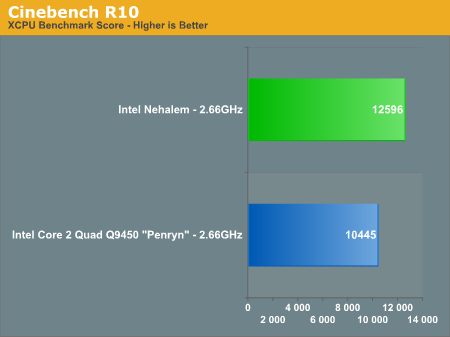
June 5, 2008

Taken at face value the above scores show an impressive 21% increase in speed for Nehalem.

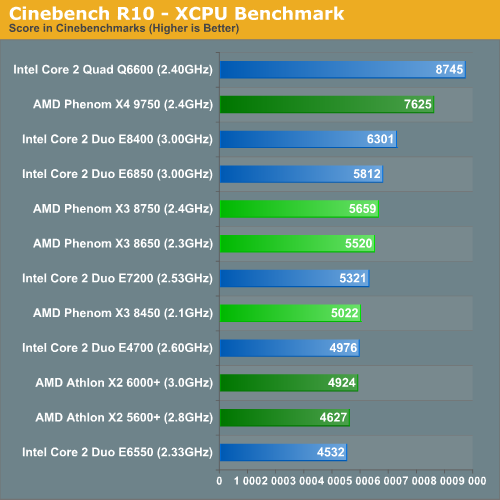
April 23, 2008

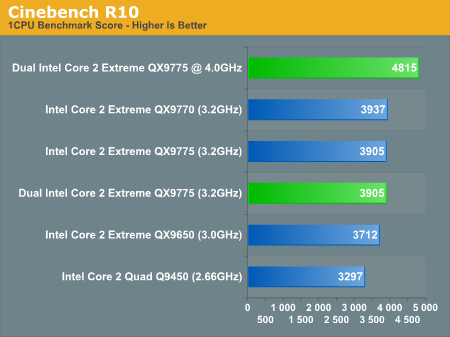
However, note that while the Q6600 score goes up 98 points from March to April the score for Phenom 9750 goes down 54 points.

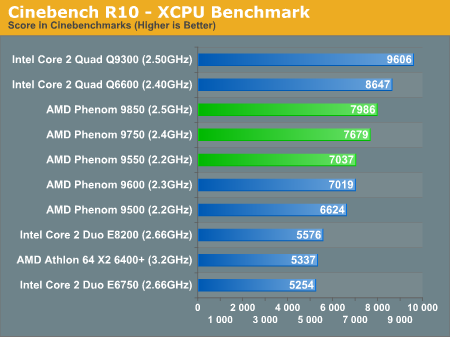
March 27, 2008

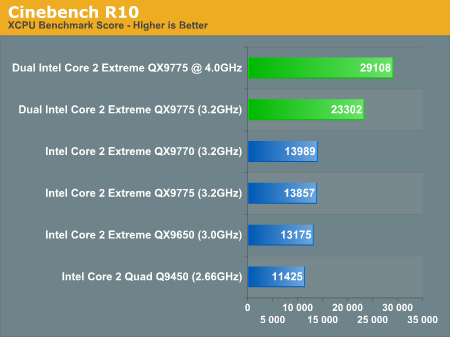
And even more strange is that the score for Q9450 was 980 points higher back in February. If this number is accurate then Nehalem's increase is reduced to 10%.

February 4, 2008

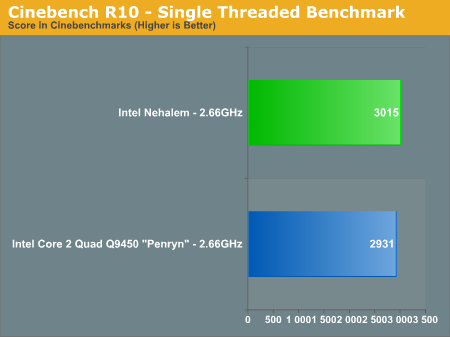
However, even a 10% cumulative gain would be very nice on top of the gains we've seen for C2D and Penryn. Unfortunately, the single threaded scores are not quite as impressive.

June 5, 2008

This would be an increase of only 3% for Nehalem.

February 4, 2008

However, the score from February was 366 points higher. If this score is correct then Nehalem would be 9% slower.

Anand is now claiming that the reduction in speed is due to a Vista update. We can check this easily enough and see if the drop in speed is consistent.

3Dsmax 9 - 21% slower
Cinebench XCPU - 9% slower
Cinebench 1CPU - 11% slower
Pov-Ray 3.7 - 13% faster
DivX - 8% faster [version change from 5.13 to 5.03]

Well, this isn't exactly consistent. 3Dsmax shows twice the slowdown of Cinebench while Pov-Ray gets faster. DivX gets faster too although this is less definitive since Anand shifts to a slight older version.

Conclusions (or perhaps Confusions):

Penryn is 21% faster when using all threads, or . . . it is only 10% faster.

Penryn is 3% faster with single threads, or . . . it is 9% slower.


I am looking forward to seeing some proper testing of Nehalem. I'm sure most are anxious to see Nehalem compared with AMD's 45nm Shanghai. I have no doubt that Nehalem is much stronger in multi-threading than C2D. I believe that Intel did this with the goal of stopping AMD from taking server share. However, this is a double edged sword since gains for Nehalem will surely be losses for Itanium.

It remains to be seen if Nehalem fairs better in benchmarking than Penryn. Penryn benefited from code that used lots of cache and was predictable enough for prefetching to work. Nehalem however has far less cache but is also much less sensitive to prediction because of the reduced memory latency. Nehalem is also much more like Barcelona in that L3 has much higher latency than L2 making the bulk of Nehalem's cache much slower than it was with Penryn. One would imagine that Nehalem's preference in program structure would be much closer to Barcelona's preference than Penryn's has been. Comparisons later this year should be interesting.